

By Ryan Carter
Building on the strong fundamentals we covered in Part 1 of our Midwest Blog Series, investors are increasingly viewing the Midwest as a strategic safe haven rather than just an opportunistic bet.
Capital flows have shifted meaningfully over the past couple of years. Institutional investors now see real advantages that stand up well amid ongoing volatility from interest rates, inflation, and broader economic pressures.
Three factors are driving this shift: stronger alignment with long-term goals, more predictable performance, and a level of risk investors can manage in today’s market.
A Shift Toward Stability Over Speculative Growth
Many investors once chased high-growth Sunbelt markets, focusing on aggressive rent increases and shorter hold periods. Today’s environment has prompted a clear evolution in thinking. Geopolitical tensions, persistent inflation, and fluctuating rates have elevated goals around income stability, capital preservation, and durable positioning for the long term.
Recent activity shows this change in action. Large institutional players have moved significant capital into Midwest multifamily assets, drawn by supply-demand imbalances, consistent rent growth, and relative accessibility compared with other regions.
For instance, Morgan Properties closed a $501 million acquisition of an 11-property, 3,054-unit portfolio across the Midwest in 2025. This transaction stood out against the oversupplied Sunbelt, where apartment starts had fallen sharply. The Midwest’s limited new supply helped sustain steady rents even as other markets cooled. As we highlighted in Part 1 of our blog series, this region continues delivering reliable rent growth that supports these kinds of large-scale commitments.
Delivering Predictable Returns in an Unpredictable Market
Midwest multifamily assets posted the highest regional cap rate in the country in 2025 at 5.8%, compared with 5.5% in other major markets. The region also recorded the largest quarter-over-quarter cap-rate compression. These figures continue a longer pattern of lower entry costs and more attractive yields than investors typically find.
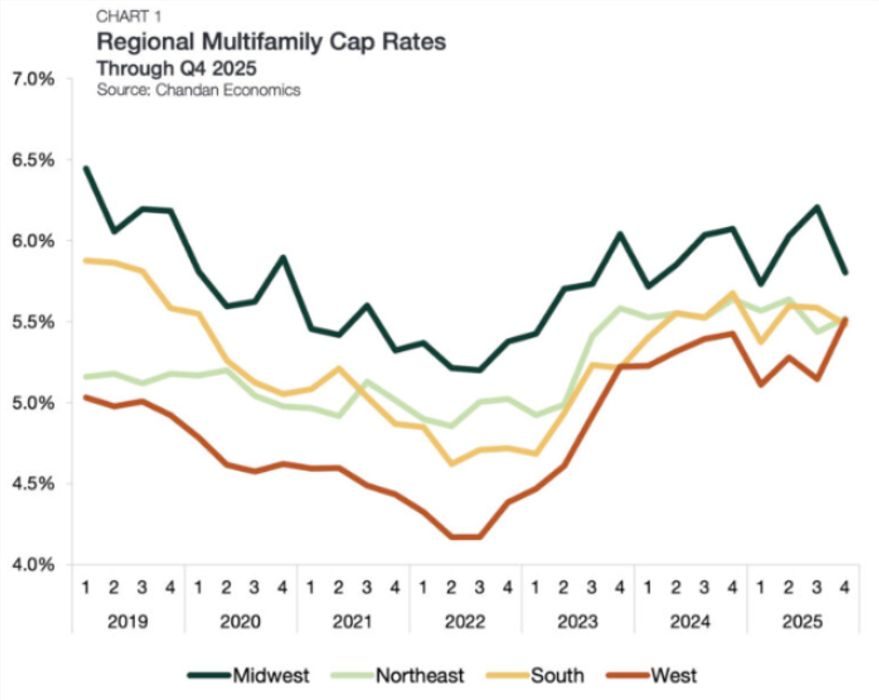
Chandan Economics, “Regional Multifamily Cap Rates Converge” (2026)
Years of heavy capital chasing Sunbelt deals have compressed cap rates there, raising purchase prices and increasing reliance on optimistic rent growth assumptions. Midwest markets avoid much of that pressure. Investors gain access to income streams that feel more reliable even when broader conditions shift.
The Timing Advantage: Manageable Risk Meets Market Momentum
Midwest multifamily has moved from an occasional opportunistic allocation toward a core portfolio holding for many investors. The region still delivers the highest cap rates nationally, yet those spreads have narrowed as more capital follows renters seeking affordable, stable locations like Columbus, Indianapolis, and the Twin Cities. These metros may not carry the flash of gateway cities, but they now offer compelling fundamentals for creating lasting value.
Early movers still capture higher going-in yields and better pricing. As institutional interest builds, those edges will gradually tighten. Investors who recognize the combination of income durability, attractive entry points, and long-term resilience that the Midwest provides, will be rewarded.
Conclusion
The movement of capital into Midwest multifamily reflects deeper changes in how investors evaluate opportunities. With stabilizing rent growth and tightening supply pipelines, the region now stands out for delivering the income consistency, measured risk, and strategic fit that sophisticated capital demands.
For advisors and investors paying close attention, the Midwest has become one of the clearest areas to deploy capital with confidence in an uncertain landscape.
What Are Other Investors Doing Right Now?
We’re compiling real-time data on how investors are allocating capital across U.S. multifamily markets. Join the conversation by taking our short survey.
Contact

Ryan Carter
rcarter@greysteel.com
913.952.0372

BJ Connolly
bconnolly@greysteel.com
515.706.3109

Zach Schneider
zschneider@greysteel.com
515.706.3161

George Strawhecker
gstrawhecker@greysteel.com
515.710.1645
More Real Estate Insights
THOUGHT LEADERS
NC Property Tax Reform, Part 3: Preserve or Build? The Cost Math on Workforce Housing Wake County, NC, in Focus
THOUGHT LEADERS
Rent Growth in Midwest Multifamily Markets: Why Consistency Is Outperforming Volatility
THOUGHT LEADERS
Rent Control in LA Under a New Mayor: What Private Investors in Class B/C Properties Need to Know Before June 2
Greysteel Advisory Expertise
Greysteel is a commercial real estate advisory firm specializing in investment sales and debt and structured finance, serving institutional clients, private investors, and middle-market operators nationwide.
The firm provides sector-focused advisory across all asset classes, delivering market intelligence, capital markets expertise, and disciplined execution.