

By Ryan Carter
Learn how shifting the narrative in multifamily markets away from regions with historically high peaks can provide investors with much needed stability.
What if the key to outperforming in multifamily investing wasn’t chasing the highest peaks, but finding the steadiest ground?
For years, high-growth Sunbelt markets dominated the narrative, promising rapid rent increases fueled by population booms and aggressive capital deployment. But as economic uncertainty reshapes investor priorities, a new question is emerging:
Where can rent growth be sustained—not just in good times, but across cycles?
The answer is clear: the Midwest
Three main factors are proving that Midwest multifamily markets are more than just secondary options, but strategic core holdings for investors seeking stability and long-term performance in an unpredictable market: 1) consistent rent growth, 2) affordability-driven demand, and 3) limited supply pressures.
Consistent Rent Growth Is Better Than Chasing the Highest Highs
In 2025, several Midwest metros –including Chicago, Milwaukee, Cleveland, and Kansas City – ranked among the highest year over year for rent growth, with only two markets outside the Midwest and Northeast ranking outside the top 15. Overall, the Midwest asking rent growth reached 3.9% year over year, outperforming the national average.
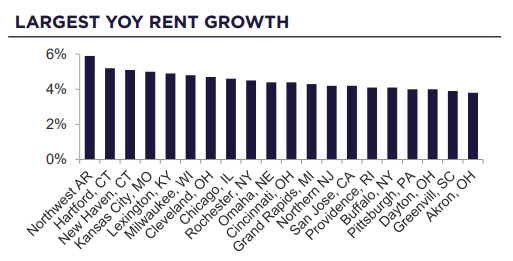
Freddie Mac Multifamily’s 2025 Outlook also found that lower-supply secondary and tertiary markets, generally located in the Northeast or Midwest, were performing best.
These factors, compounded with strong occupancy trends and stable local demand drivers, showcase the Midwest multifamily market’s ability to sustain growth across cycles.
Affordable Housing Does More Than Just Protect Tenants
In 2024, Freddie Mac estimated that if housing costs were more affordable, the U.S. would have added 1 million more households that year, highlighting how lower rent levels relative to income contribute greatly to the formation of household’s and help support the retention of tenants.
Affordability also provides investors with downside protection, as lower-rent housing has shown stronger risk-adjusted performance and resilience across economic cycles.
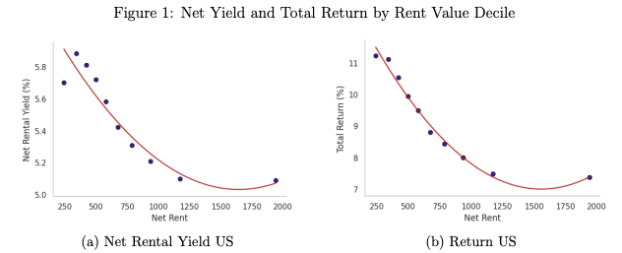
National Bureau of Economic Research, “An Alpha in Affordable Housing?” (2025)
Rents in the Minneapolis-Saint Paul metro remain among the most affordable relative to peer metros; the Midwest’s markets are affordable. This insulates them from the volatility seen in overbuilt Sunbelt regions by leading to greater tenant retention, more consistent household formation, and reducing sensitivity to economic shocks.
Limited Supply Pressures Are a Strategic Advantage
Currently, high levels of supply are keeping vacancy rates elevated and rent growth muted, leading to higher-supply markets – such as the Sun Belt and Mountain West who are receiving the bulk of new supply– to weaken. In contrast, metros that are supply-constrained –such as Chicago, Cleveland, Cincinnati, and Louisville – have seen above-average rent growth and are expected to outperform (Freddie Mac, 2025).
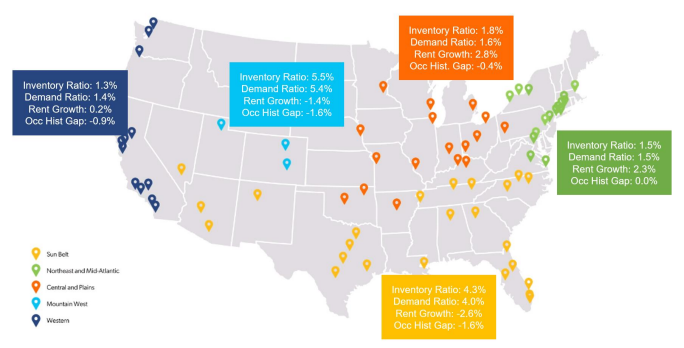
Freddie Mac, “2025 Multifamily Outlook” (2025)
The Midwest has avoided the oversupply issues seen in Sunbelt markets due to meaningfully lower construction starts, slower delivery pipelines, and less exposure to lease-up competition. This supply constraint drives tighter operating conditions and protects the Midwest from upward vacancy pressure and downward rent pressure if demand softens (Freddie Mac, 2025).
The Bottom-Line for Multifamily Investors
In an environment defined by uncertainty, consistency is becoming one of the most valuable attributes in multifamily investing. The Midwest is backed by affordability-driven demand and limited supply pressures that lead to consistent rent growth year after year.
Investors need to recognize that Midwest markets are no longer secondary—they are strategic.
Contact the Greysteel Midwest Multifamily Investment Sales Team
Rather than prioritize peak growth, investors need to identify sustainability across cycles and align it with the economic fundamentals of each submarket so that they can have reliable underwriting assumptions. To do this, they need local market knowledge and the analytical lens of the right experts.
Greysteel’s national, collaborative platform of specialized teams gives their clients a significant transaction advantage by complementing big picture market trends with the nuances of each submarket and asset class. The Midwest Multifamily Investment Sales Team is fully equipped to help investors navigate this volatile environment to find the best solution to help their capital grow.
We want to hear from multifamily investors across the country. We’ve compiled some questions so you can let us know how you’re moving your capital in today’s market and further highlight how to position assets in local markets like the Midwest.
Let us know your thoughts. Answer the survey here.
Contact

Ryan Carter
rcarter@greysteel.com
913.952.0372
Greysteel Advisory Expertise
Greysteel is a commercial real estate advisory firm specializing in investment sales and debt and structured finance, serving institutional clients, private investors, and middle-market operators nationwide.
The firm provides sector-focused advisory across all asset classes, delivering market intelligence, capital markets expertise, and disciplined execution.